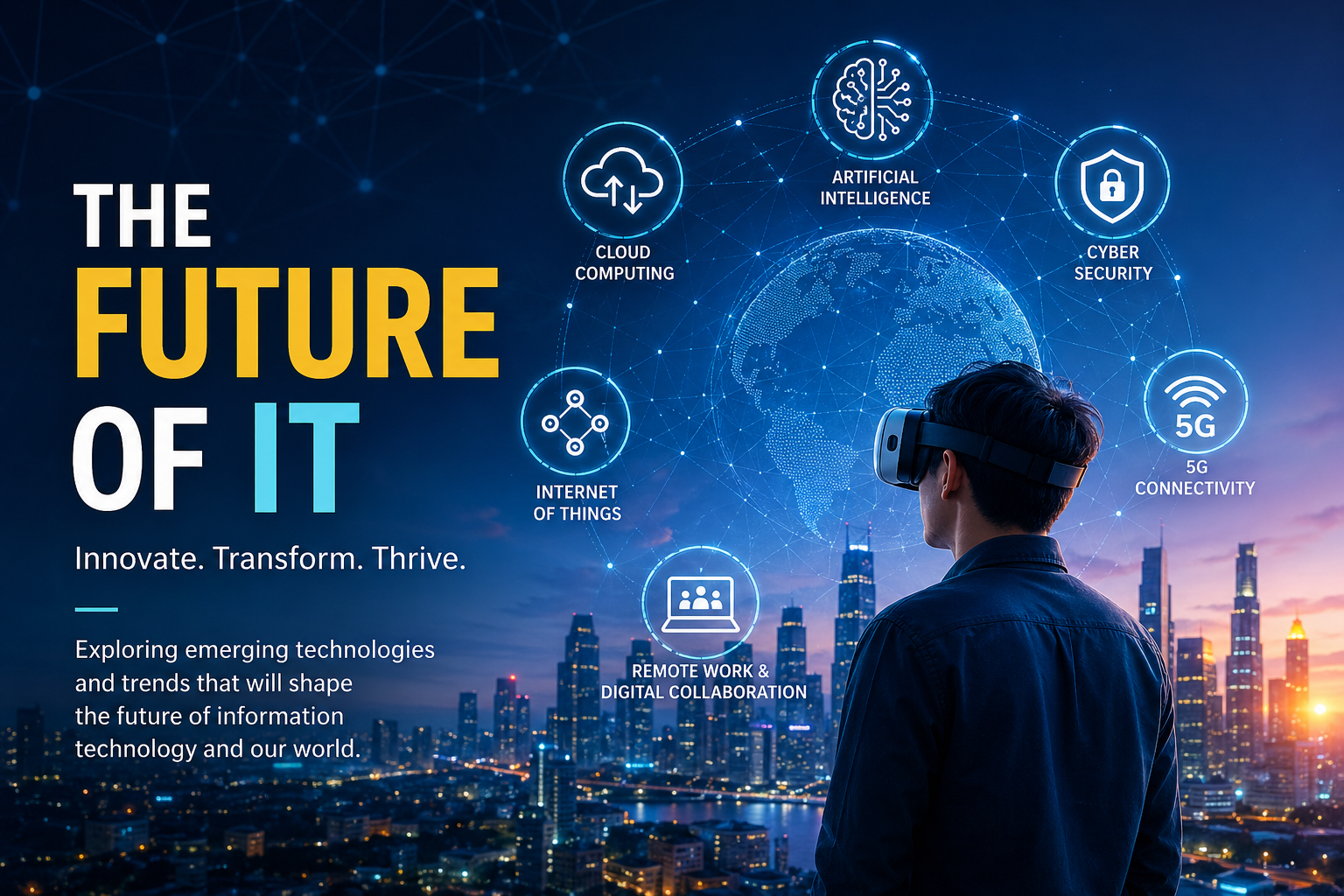
The world of Information Technology (IT) is evolving faster than ever before. From artificial intelligence to cloud computing, the future promises innovations that will reshape industries, economies, and everyday life. Understanding these trends is essential for businesses, professionals, and students who want to stay ahead in a rapidly changing digital landscape.
1. Rise of Artificial Intelligence and Automation
Artificial Intelligence (AI) is no longer just a concept—it is becoming a core part of modern IT systems. In the future, AI will automate repetitive tasks, enhance decision-making, and improve efficiency across industries. From chatbots handling customer service to advanced algorithms predicting market trends, AI will continue to redefine how we work.
Automation will also reduce human intervention in routine processes, allowing professionals to focus on creative and strategic tasks. However, it will also require new skills, making continuous learning essential.
2. Cloud Computing Dominance
Cloud computing has already transformed how businesses store and manage data. In the future, cloud technology will become even more powerful, flexible, and secure. Organizations will rely heavily on cloud platforms for scalability, remote access, and cost efficiency.
Hybrid and multi-cloud environments will become standard, allowing companies to combine different cloud services for better performance and reliability.
3. Cybersecurity Will Be More Critical Than Ever
As technology advances, so do cyber threats. The future of IT will heavily focus on cybersecurity to protect sensitive data and systems. With the rise of remote work and digital transactions, companies will invest more in advanced security solutions like biometric authentication, zero-trust architecture, and AI-driven threat detection.
Cybersecurity professionals will be in high demand as organizations strive to safeguard their digital assets.
4. Internet of Things (IoT) Expansion
The Internet of Things (IoT) is connecting everyday devices to the internet, from smart homes to industrial machines. In the future, billions of devices will be interconnected, creating smarter environments and more efficient systems.
This expansion will improve industries like healthcare, agriculture, and transportation, but it will also require strong data management and security systems.
5. 5G and Faster Connectivity
The rollout of 5G technology will revolutionize connectivity. With faster speeds and lower latency, 5G will enable innovations like autonomous vehicles, smart cities, and real-time data processing.
This will open new opportunities for businesses and developers to create advanced applications that were previously not possible.
6. Growth of Remote Work and Digital Collaboration
The IT industry has already enabled remote work, but the future will take it further. Advanced collaboration tools, virtual reality workspaces, and AI-driven productivity systems will make remote work more efficient and immersive.
Companies will adopt flexible work models, allowing employees to work from anywhere in the world.
7. Demand for Skilled IT Professionals
As technology continues to evolve, the demand for skilled IT professionals will grow. Fields like AI, data science, cybersecurity, and cloud computing will offer numerous career opportunities.
To succeed in the future IT landscape, individuals must focus on continuous learning, adaptability, and problem-solving skills.